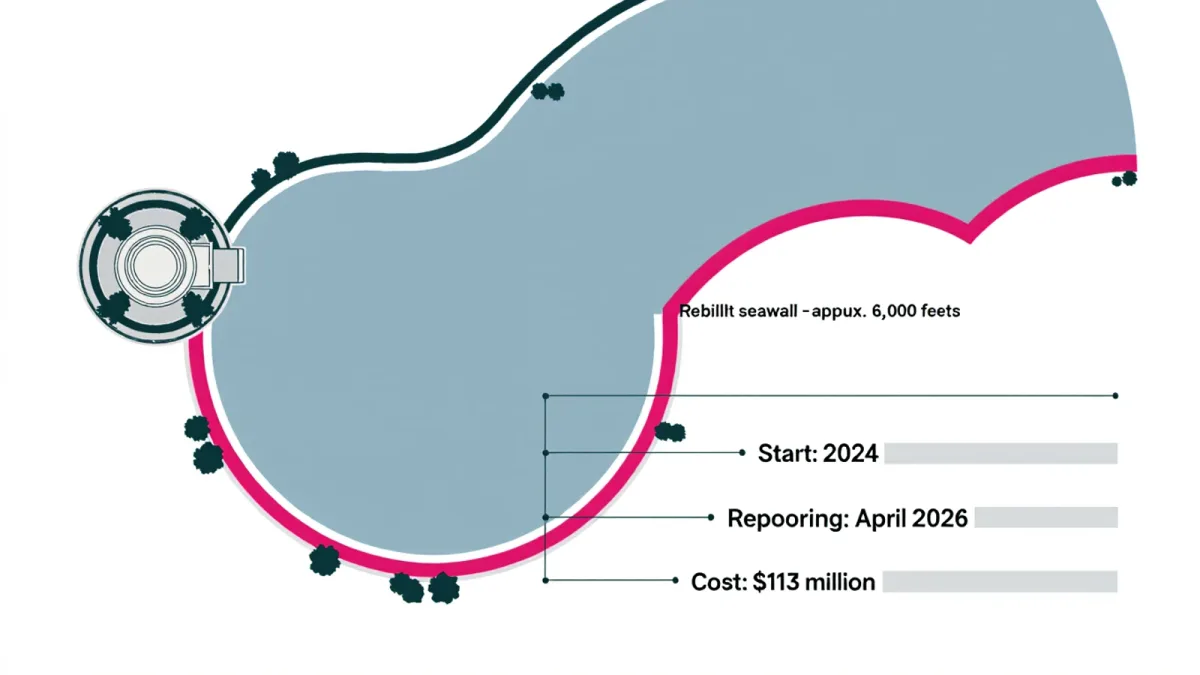
The walk around the Jefferson Memorial reopened on April 21, 2026, per National Park Service announcements, completing roughly 6,000 feet of reconstructed seawall that had kept the Tidal Basin's western shore fenced through the entire cherry-blossom season. Work that began in 2024 finished months ahead of schedule and, per the National Park Service and project partners, under budget, at a project cost reported near 113 million dollars.
The fences were the visible half of a slow emergency. For years the basin's daily tidal flooding had poured over a sinking seawall, closing the path around the memorial dozens of times a year and drowning the roots of the cherry trees nearest the water, including the crowd-famous tree known as Stumpy. The rebuilt wall raises and re-anchors the shoreline between the Jefferson Memorial and the basin; a second phase along the adjacent Potomac riverbank continues into May 2026.
What did the reconstruction change?
The new seawall lifts the promenade above the highest tides and was rebuilt in sections so that, per the Park Service, the basin never fully closed to the public at once. Tree planting follows the masonry: the Park Service has scheduled hundreds of new trees for spring 2026, among them descendants of Stumpy grown from its cuttings, replanted along the same shore.
Related stories: Seville readies its streets for a Holy Week that begins on Palm Sunday · Thirty restored places and practices won Europe's top heritage prizes.
Why did the cherry blossoms lose their walk?
Peak bloom in late March and early April 2026 drew the usual crowds to the east bank, while the memorial shore stayed closed. The trade was deliberate: contractors used the blossom season, when visitation crowds keep contractors away elsewhere in the calendar, to finish the wall before summer storms.
What should visitors expect now?
The full loop — Washington Monument, the FDR Memorial shore, the Jefferson Memorial — is walkable again, with the Potomac stretch the last piece under construction. Daily tidal flooding, which once closed the path an average of about 90 days a year by the Park Service's count, now meets a wall designed for a rising century.
The project was the first built piece of a larger plan for the National Mall's vulnerable shores, drafted after chronic tidal flooding made routine closures a running news item. Its early finish gives the agencies a working template for the Potomac phases that follow.